


In Memoriam:
Who Was Adam Smith? A Short Biography
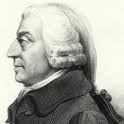
Adam Smith (1723 to 1790) was a Scottish moral philosopher and political economist, best known for two books: The Theory of Moral Sentiments (1759) and An Inquiry into the Nature and Causes of the Wealth of Nations (1776). He is often called the father of modern economics, a label that simplifies a career spent mostly as a professor of moral philosophy, in an age when “economics” had not yet become a separate subject.
This short biography follows his life in order. Where records are thin, such as his exact birth date, it says so.
Early years in Kirkcaldy
Smith was born in Kirkcaldy, a port town in Fife, Scotland. He was baptised on 5 June 1723, and his actual birth date is not recorded. His father, also named Adam, who had worked as a customs official, died a few months before he was born, and Smith was raised by his mother, Margaret Douglas. Few personal details survive from his childhood, and anecdotes retold in older biographies are not always reliable.
Glasgow and Oxford
At about fourteen, Smith entered the University of Glasgow, where he studied under the philosopher Francis Hutcheson, a leading figure of the Scottish Enlightenment. In 1740 he went to Balliol College, Oxford, on a scholarship, and stayed until 1746. He later remembered the experience without much warmth. He felt that teaching there was uninspiring, a view he expressed in his later writing on education.
Edinburgh lectures and the Glasgow chair
After leaving Oxford, Smith gave public lectures in Edinburgh in the late 1740s on rhetoric and literature. In the early 1750s he returned to Glasgow, first as professor of logic and then, from 1752, as professor of moral philosophy. A friendship with David Hume, the philosopher and historian, began in this period and lasted until Hume’s death in 1776.
The Theory of Moral Sentiments
Smith’s first book, published in 1759, asks how people form moral judgements. His answer centres on sympathy, a capacity to imagine ourselves in another person’s situation, and on the “impartial spectator”, an imagined observer who helps us judge our own conduct. The book was well received and revised repeatedly up to the sixth edition, published in the year of his death. Readers who see Smith only as an economist are often surprised by how much of his thinking concerns ethics.
Travel in France
In 1764 Smith left his university post to tutor the young Duke of Buccleuch, travelling with him in France and Switzerland for about two and a half years. In France he met leading thinkers, including economists associated with the Physiocrat school, such as François Quesnay and Anne-Robert-Jacques Turgot. Their ideas about agriculture and wealth influenced his thinking, even where he disagreed.
Writing The Wealth of Nations
Smith returned to Kirkcaldy and spent most of the next decade writing his major work. It appeared in March 1776 and examined how nations become wealthy: the division of labour, markets, money, the role of trade, taxation, and the duties of government. It argued against the mercantilist view that wealth meant stockpiles of gold and silver, and offered a famous account of how a pin factory could multiply output by breaking work into small tasks.
For scholars, the text is also a record of a particular time, and the sources Smith drew on are a recurring subject of research. The Adam Smith Review, described on its homepage, devoted a volume to Adam Smith and his sources.
Later career and death
In 1778 Smith was appointed one of the Commissioners of Customs in Scotland, a post that moved him to Edinburgh. He never married. He died in Edinburgh on 17 July 1790 and was buried in the Canongate Kirkyard. Shortly before his death he arranged for many of his unpublished papers to be burned, which is part of why some of his lecture material survives only through student notes.
Where his works are collected
The standard scholarly edition is the Glasgow Edition of the Works and Correspondence of Adam Smith, published by Oxford University Press in the 1970s and 1980s, which includes the two major books, his essays, lectures and letters. The Adam Smith Review has long published research on his work, including the volume New Light on the Wealth of Nations.
Common misunderstandings
- “Smith opposed government.” In the Wealth of Nations he assigns government duties, including defence, justice and some public works, and discusses taxation at length.
- “Smith said greed is good.” His moral philosophy emphasises sympathy and justice. Self-interest has a place in his analysis of exchange, but it is not his whole account of human nature.
- “He invented economics.” Earlier writers, including Hume, Quesnay and Richard Cantillon, had analysed economic questions. Smith’s achievement was a broad and influential synthesis.
Frequently asked questions
When was Adam Smith born?
He was baptised on 5 June 1723, and the exact day of his birth is not recorded. Many sources therefore give 1723 only.
What is Adam Smith best known for?
He is best known for The Wealth of Nations (1776), a foundational work in economic thought, and for The Theory of Moral Sentiments (1759), a book on ethics.
Was Adam Smith an economist?
He was a professor of moral philosophy who wrote about economics. The term “political economy” was used for the field at that time.
Where is Adam Smith buried?
He is buried in the Canongate Kirkyard in Edinburgh.
Further reading
For a concise reference, the Encyclopaedia Britannica has an entry on Adam Smith. For academic study, the Review’s volumes on his sources and on the Wealth of Nations offer deeper discussion.